
In a rapidly changing business landscape, with developing technology and ever-more flexible tools and resources, organisations are faced with a new reality: to stand still and watch others forge ahead, or to grasp the opportunities offered for infinite improvement.
As the pattern and nature of work dictate different rules of engagement, businesses constantly seek ways to innovate, enhance product development, and stay ahead of the competition.
One strategy that has gained significant traction is the in-housing of creative agency functions.
The impact on innovation, product research, and development is profound. Never before have product, sales and marketing been quite so close or conveniently optimisable.
How can this strategic shift drive more sustainable growth and offer improved competitive advantage?
Rapid technological advancements and shifting consumer preferences ensure companies continually adapt to remain relevant. Creative agencies play a pivotal role in shaping a brand’s identity, its marketing strategies, and product development efforts. The decision to bring these functions in-house is a transformative one, reshaping how organisations approach their innovation and how efficiently they conduct their product research – allowing for more agile development with speedier times to market.
I. The Creative Agency In-Housing Trend:
The trend of creative agency in-housing has gained momentum in recent years. Originally production and delivery-based, this has continued to further encompass media and creativity, offering greater collaborative possibilities, both cross-departmentally and with external agencies. These capabilities and resources can plug into existing marketing functions and collaborate to utilise stakeholder inputs more efficiently in a fraction of the project time. Barclaycard highlighted this hybrid approach a few years ago and others have followed since https://www.marketingweek.com/barclaycard-in-house-creative-agency/
Companies across industries are recognising the potential benefits of consolidating creative functions under their roofs. This shift enables greater control, efficiency, and agility in addressing the ever-evolving needs of their customer base. And the commercial realities offered through the repurposing and recycling of creative work across media channels and territories globally. And these creative collaborations are part of a mindset which are predisposed towards design-thinking and incremental innovation at pace, as a part of an innovation culture.
II. Fostering a Culture of Innovation:
Innovation is the primary driver of growth and the lifeblood of any organisation looking to maintain its competitive edge. In-housing encourages innovation culture by breaking down silos and fostering collaboration. Cross-functional teams can more readily exchange ideas, fuelling creativity and breakthrough thinking. This collaborative atmosphere enables faster ideation and testing, facilitating the rapid development of new products and services.
Enhanced by new technology like machine learning, the timing to initiate, test and learn is considerably shortened. Companies now deploying AI within their innovation and R&D cycles are already 6 times ahead of those lagging behind according to McKinsey (3/23).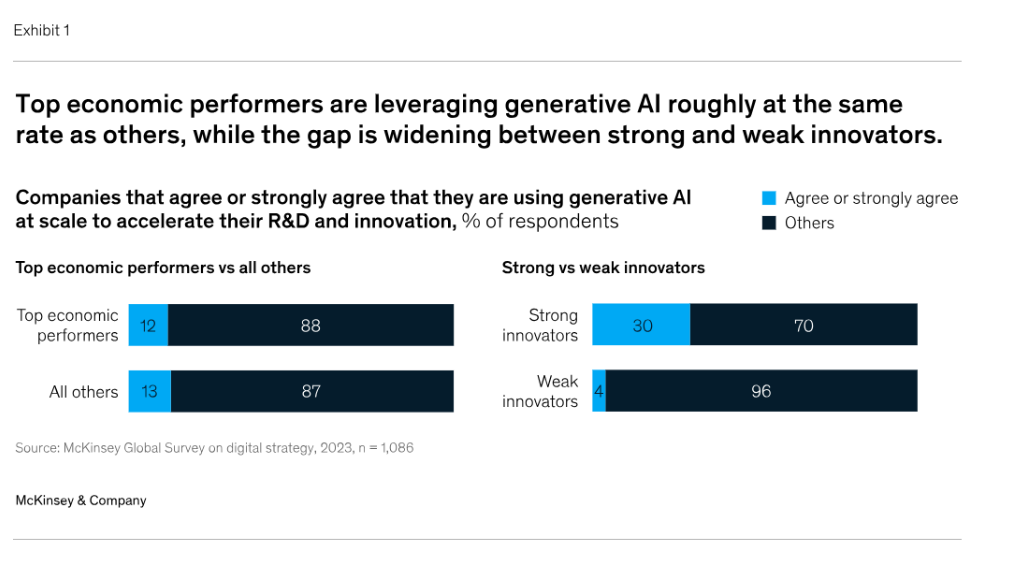
The willingness to disrupt themselves, to accept failures as a part of success and to invest in differentiated business insights – propel companies towards pursuing bigger ideas to stay ahead. Combined resources from internal and external networks strengthen this pursuit of growth opportunities, offering a roadmap through future uncertainty.
III. Deepening Product Research:
In-house creative agencies have an intimate understanding of their organisation’s objectives, target audience, and unique selling propositions. This deep understanding allows them to align their creative strategies with the company’s overarching goals. As a result, product research becomes more customer-centric, helping organisations develop offerings that precisely match market demand. However for in-housing to work there still has to be a ‘distance’ or internal firewall maintained between the creative teams and the eager marketeers keen to cram every minor point into copy.
Creativity is an unpredictable process, but closer insight and understanding can go a long way to ensuring outcomes better resonate with both customer and consumer.
IV. Accelerating Product Development:
Efficient product development is paramount today. In-housing streamlines the product development process by reducing communication overhead and enhancing coordination. Often this means using “innovation sprints” and design-thinking for rapid collaborative ideation and working towards a minimum viable product. This expedites the time-to-market for new products and services, ensuring organisations remain agile and responsive to market trends.
Combining cross-functional teams across product, sales and marketing with external agency services in an embedded agency operation can pay dividends. Being closer to the core product or service will enable a higher degree of real-time development and improvement. Feedback loops are shorter and involvement levels are higher, more regular and more consistent than ad hoc workshopping. Again, objectivity enhanced with a certain distance is key.
V. Cost Efficiency:
While in-housing creative functions may involve initial investments, the long-term benefits are undeniable. Companies can reduce the costs associated with external agencies, translating savings into increased research and development budgets. This infusion of resources further supports product innovation, enabling organisations to stay at the forefront of their industries. The agency marketplace allows for project-based resourcing and using external specialised consultancy services on a strictly as-needed basis, rather than on fixed retainers. This flexibility provides much tighter budgetary control and more accurate forecasting.
VI. Two Scenarios:
Company A: By bringing its creative agency functions in-house, Company A reduced its product development cycle by 30%, resulting in a 20% increase in revenue within the first year.
Company B: Through in-housing, Company B established a culture of innovation that led to the development of a breakthrough product, capturing a significant market share and surpassing industry competitors.
Conclusion:
Creative agency in-housing is no longer a trend but a strategic imperative for organisations looking to drive innovation, enhance product research, and streamline development processes. Should any pitch/ review process now include an in-housing option? Should the trade press now consider in-house offerings on an equal basis to legacy agencies?
The impact is undeniable, as companies that have embraced this shift are witnessing significant improvements in their competitiveness and bottom line. But, this should be considered against the challenges of talent acquisition and retention, ensuring creative diversity and avoiding echo-chamber thinking.
To thrive, companies must recognise the transformative potential of in-housing creative functions and strengthening external inputs.
Working together with external resources “plugged-in” to optimise the benefit and to avoid limiting growth potential.
As the business landscape continues to evolve, in-house agencies will surely increasingly act as powerful catalysts to speed up both innovation and time to market.